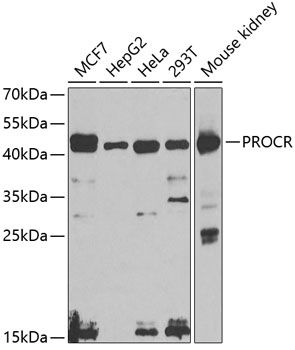
Mucin is a large family of molecules that add a protective layer to respiratory epithelial cells to shield them from microorganisms and pollutants in the local environment. Among the known members of this family, some are produced in a cell-type and tissue-specific manner, suggesting that each mucin member has different biological functions. Some members aggregate after secretion to form a gel-like substance covering the epithelial layer. CA125, also known as MUC16, is a mucin protein that may be found in the form of a transmembrane or secreted protein, used for monitoring the progress of treatment for epithelial ovarian cancer. The CA125 molecule is almost certainly a glycoprotein with an o bond. Its size and charge are uneven, and the most likely reason is that its side chains are constantly de-sulfoglycosylated during its life cycle in body fluids. Under natural conditions, it is a very large complex (possibly up to 400,000 daltons). MUC16 is a member of the mucin family, which are high-molecular-weight, O-glycosylated proteins that play an important role in the formation of mucosal barriers and are found on the top surface of epithelial cells. It contains an amino-terminal extracellular domain, a large tandem repeat sequence, and a transmembrane domain with a short cytoplasmic domain. MUC16 is associated with lung cancer and ovarian cancer. It provides a protective lubricating barrier against particles and pathogens on the mucosal surface.